
Shaders
php-vio provides a complete shader pipeline: write GLSL, compile to SPIR-V, cross-compile to the active backend, and introspect at runtime.
Shader Formats
| Constant | Description |
|---|---|
VIO_SHADER_AUTO | Auto-detect from SPIR-V magic number |
VIO_SHADER_GLSL | GLSL → SPIR-V → cross-compile to backend |
VIO_SHADER_SPIRV | Raw SPIR-V binary |
VIO_SHADER_MSL | Metal Shading Language (Metal only) |
VIO_SHADER_GLSL_RAW | GLSL passed directly (OpenGL only) |
Writing GLSL Shaders
The recommended approach is to write GLSL and let php-vio handle the rest:
$shader = vio_shader($ctx, [
    "vertex" => "#version 450
        layout(location=0) in vec3 aPosition;
        layout(location=1) in vec2 aTexCoord;

        layout(std140, binding=0) uniform Matrices {
            mat4 uProjection;
            mat4 uView;
            mat4 uModel;
        };

        layout(location=0) out vec2 vTexCoord;

        void main() {
            gl_Position = uProjection * uView * uModel * vec4(aPosition, 1.0);
            vTexCoord = aTexCoord;
        }
    ",
    "fragment" => "#version 450
        layout(location=0) in vec2 vTexCoord;
        layout(binding=1) uniform sampler2D uTexture;
        layout(location=0) out vec4 fragColor;

        void main() {
            fragColor = texture(uTexture, vTexCoord);
        }
    ",
]);
Conventions that keep one source portable across all backends:
#version 450– the GLSL dialect glslang compiles to SPIR-V; php-vio then emits the backend's native language.layout(location = n)on vertex inputs, on the varyings between stages and on fragment outputs (location = iselects the colour attachment with multiple render targets).- Uniforms either in a
layout(std140, binding = 0) uniform Block { … }block or as plainuniform mat4 u_mvp;– both are written withvio_set_uniform()by member name on every backend (php-vio 2.10.1+ on OpenGL). Binding 0 is the root constant buffer on Direct3D 12. Prefer the block form for large struct arrays (Metal packs them std140 only inside a block). - Samplers: bind the texture to a unit with
vio_bind_texture($ctx, $tex, n)and tell the shader which unit withvio_set_uniform($ctx, 'uTexture', n)– the classic OpenGL convention, and the one D3D/Metal resolve at draw time. Alayout(binding = n)qualifier is optional and does not select the unit on D3D/Metal; without avio_set_uniform()call a sampler reads unit 0. One unit holds one sampler (2D, 3D or cube). - Compute shaders declare
layout(local_size_x = …); their params block lives atbinding = 2(see Compute).
Missing location / binding qualifiers are auto-assigned by glslang, so older #version 330 core sources compile too – but explicit numbers are what make the reflection, vio_bind_texture() slots and MRT outputs predictable.
Feeding that shader from PHP:
vio_bind_pipeline($ctx, $pipeline);
vio_set_uniform($ctx, 'uProjection', $proj);   // block members by name, 16 floats each
vio_set_uniform($ctx, 'uView', $view);
vio_set_uniform($ctx, 'uModel', $model);
vio_bind_texture($ctx, $texture, 1);           // unit 1 …
vio_set_uniform($ctx, 'uTexture', 1);          // … is what the sampler reads
vio_draw($ctx, $mesh);
Compilation Pipeline
When format is VIO_SHADER_GLSL (the default):
GLSL source
  → glslang → SPIR-V binary
    → SPIRV-Cross → Backend-native format
      OpenGL: GLSL matching the context (330 … 460)
      Metal:  MSL
      Vulkan: SPIR-V (passthrough)
      D3D11:  HLSL → D3DCompile → DXBC (SM 5.0)
      D3D12:  HLSL → D3DCompile → DXBC (SM 5.1)
This requires --with-glslang and --with-spirv-cross at build time.
Raw GLSL (OpenGL Only)
Skip the SPIR-V pipeline for maximum compatibility:
$shader = vio_shader($ctx, [
    "vertex"   => $glsl_source,
    "fragment" => $glsl_source,
    "format"   => VIO_SHADER_GLSL_RAW,
]);
WARNING
Raw GLSL shaders only work with the OpenGL backend. They cannot be cross-compiled to Vulkan, Metal, or DirectX.
Shader Reflection
Introspect compiled shaders at runtime:
$info = vio_shader_reflect($shader);Returns:
[
    "vertex" => [
        "inputs" => [
            ["name" => "aPosition", "location" => 0, "format" => "vec3"],
            ["name" => "aTexCoord", "location" => 1, "format" => "vec2"],
        ],
        "ubos" => [
            ["name" => "Matrices", "set" => 0, "binding" => 0, "size" => 192],
        ],
        "textures" => [],
        "uniforms" => [],
    ],
    "fragment" => [
        "inputs" => [...],
        "ubos" => [],
        "textures" => [
            ["name" => "uTexture", "set" => 0, "binding" => 0],
        ],
        "uniforms" => [],
    ],
]
Reflection requires --with-spirv-cross at build time.
Setting Uniforms
vio_set_uniform() writes a value by name – plain uniforms and members of uniform Block { … } blocks alike, in any stage. Arrays are set per element (uBones[3], u_lights[2].pos); a mat4 is 16 floats, column-major.
vio_set_uniform($ctx, "uColor", [1.0, 0.0, 0.0, 1.0]);  // vec4
vio_set_uniform($ctx, "uTime", 3.14);                      // float
vio_set_uniform($ctx, "uEnabled", 1);                      // int
vio_set_uniform($ctx, "uModel", $mat4);                    // 16 floats
vio_set_uniform($ctx, "uBones[2]", $mat4);                 // array element
vio_set_uniforms($ctx, ["uTime" => 3.14, "uColor" => [1, 1, 1, 1]]);
Values are staged and pushed right before the draw, so the order of vio_set_uniform() / vio_bind_texture() / vio_bind_pipeline() calls does not matter within a frame.
Direct UBO binding is not portable yet
vio_uniform_buffer() + vio_bind_buffer() currently feed a graphics shader's block on D3D11 only: OpenGL flattens blocks into plain uniforms (nothing to bind) and D3D12 overwrites the root constant buffer with the shader's staged uniforms at draw time (Metal uses the same staging model). Use vio_set_uniform() for graphics shaders; uniform buffers remain useful as compute params via vio_compute_set_uniforms().
Built-in Shaders
php-vio includes built-in shaders for the 2D renderer and a default 3D shader. These are compiled into the extension and used automatically when no custom shader is specified.
shaders/default_shaders.h– Default 3D vertex/fragment shadershaders/shaders_2d.h– 2D batch renderer shader
Geometry & tessellation stages
vio_shader() accepts further stages next to vertex and fragment:
| Key | Stage | Feature flag |
|---|---|---|
geometry | Geometry shader | VIO_FEATURE_GEOMETRY |
tess_control + tess_eval | Tessellation control and evaluation, always as a pair | VIO_FEATURE_TESSELLATION |
Every backend can run both: OpenGL from 3.2 (geometry) and 4.0 (tessellation), Direct3D 11 / 12 and Vulkan natively, Metal through compute kernels php-vio generates. Check the flag first – where it is false, vio_shader() returns false with a warning. vio_feature_info() tells whether a stage runs natively or emulated.
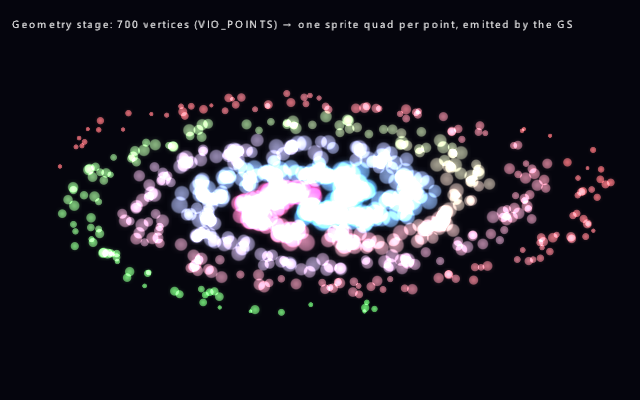 | 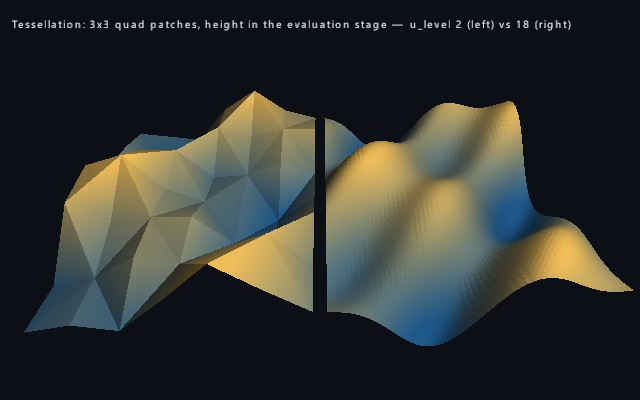 |
Geometry stage – VIO_POINTS, one sprite quad per vertex | Tessellation – quad patches, level 2 (left) vs 18 (right) |
// Point sprites: one vertex in, a quad out.
$vs = <<<'GLSL'
#version 450
layout(location = 0) in vec3 aPos;
layout(location = 0) out vec4 vPos;
void main() { vPos = vec4(aPos, 1.0); gl_Position = vPos; }
GLSL;

$gs = <<<'GLSL'
#version 450
layout(points) in;
layout(triangle_strip, max_vertices = 4) out;
layout(location = 0) in vec4 vPos[];
uniform float u_half;
void main() {
    vec4 c = vPos[0];
    gl_Position = c + vec4(-u_half, -u_half, 0, 0); EmitVertex();
    gl_Position = c + vec4( u_half, -u_half, 0, 0); EmitVertex();
    gl_Position = c + vec4(-u_half,  u_half, 0, 0); EmitVertex();
    gl_Position = c + vec4( u_half,  u_half, 0, 0); EmitVertex();
    EndPrimitive();
}
GLSL;

$fs = <<<'GLSL'
#version 450
layout(location = 0) out vec4 fragColor;
void main() { fragColor = vec4(1.0, 0.6, 0.2, 1.0); }
GLSL;

$points = vio_mesh($ctx, [
    'vertices' => [-0.5, 0.0, 0.0,   0.0, 0.0, 0.0,   0.5, 0.0, 0.0],
    'layout'   => [VIO_FLOAT3],
    'topology' => VIO_POINTS,
]);

if (vio_supports_feature($ctx, VIO_FEATURE_GEOMETRY)) {
    $shader   = vio_shader($ctx, ['vertex' => $vs, 'geometry' => $gs, 'fragment' => $fs]);
    $pipeline = vio_pipeline($ctx, ['shader' => $shader, 'topology' => VIO_POINTS,
                                    'cull_mode' => VIO_CULL_NONE, 'depth_test' => false]);
    vio_bind_pipeline($ctx, $pipeline);
    vio_set_uniform($ctx, 'u_half', 0.05);   // uniforms of the geometry stage work like any other
    vio_draw($ctx, $points);
}
Tessellation works the same way. A pipeline whose shader has tessellation stages always draws VIO_PATCHES and takes the control-point count from patch_vertices (1 to 32, default 3):
$shader   = vio_shader($ctx, ['vertex' => $vs, 'tess_control' => $tcs, 'tess_eval' => $tes, 'fragment' => $fs]);
$pipeline = vio_pipeline($ctx, ['shader' => $shader, 'patch_vertices' => 4]);
vio_set_uniform($ctx, 'u_level', 16.0);   // e.g. a control-stage uniform driving gl_TessLevelOuter / Inner
On Direct3D an HLSL source can replace a translated stage: 'hlsl' => ['geometry' | 'tess_control' | 'tess_eval' => $source] (API).
Tips
- Use
layout(std140)for uniform blocks – it guarantees consistent memory layout across backends - Avoid
push_constant(Vulkan-specific) if you want cross-backend shaders - Use
binding/locationqualifiers explicitly – don't rely on auto-assignment - Render-target textures are row 0 = bottom on OpenGL and row 0 = top on D3D/Metal – flip V when sampling an offscreen target on those backends (see Render Targets → Orientation)
- A shader stage can bind 16 textures on every backend (2D, 3D, cubemap, shadow samplers together);
vio_texture_units()reports when a backend offers more – stay within 16 for cross-backend portability - Test with
vio_shader_reflect()to verify your shader's interface matches your vertex data