
Compute
GPU compute: storage buffers, storage images, dispatch (synchronous or recorded into the frame) and the readback-free path from a compute-written buffer into the vertex stage.
Gate with vio_supports_feature($ctx, VIO_FEATURE_COMPUTE) – OpenGL ≥ 4.3 (never on macOS), D3D11, D3D12, Vulkan and Metal report it. Storage images additionally need VIO_FEATURE_STORAGE_IMAGE, the vertex-stage path VIO_FEATURE_VERTEX_STORAGE.
vio_compute_pipeline
VioComputePipeline|false vio_compute_pipeline(VioContext $context, array $config)| Key | Type | Description |
|---|---|---|
source | string | GLSL compute shader (#version 450). local_size_* is read from the reflection and defines the dispatch geometry |
$cp = vio_compute_pipeline($ctx, ["source" => <<<'GLSL'
#version 450
layout(local_size_x = 64) in;
layout(std430, binding = 0) readonly  buffer In  { float a[]; };
layout(std430, binding = 1) writeonly buffer Out { float b[]; };
layout(std140, binding = 2) uniform Params { int count; float scale; int p0; int p1; };
void main() {
    uint i = gl_GlobalInvocationID.x;
    if (i >= uint(count)) return;
    b[i] = a[i] * scale;
}
GLSL]);
The params uniform block is always binding = 2; storage buffers and images use their GLSL binding as the slot number.
vio_storage_buffer
VioBuffer|false vio_storage_buffer(VioContext $context, array $config)| Key | Type | Default | Description |
|---|---|---|---|
size | int | required | Size in bytes |
data | string | – | Initial contents (input buffers); omitted = zero-filled (output buffers) |
stride | int | 4 | Element stride. Use 4 for raw float[]/int[] arrays – D3D12 maps other strides to structured buffers |
vio_compute_bind_buffer
void vio_compute_bind_buffer(VioContext $context, VioComputePipeline $pipeline, VioBuffer $buffer, int $slot, int $access)Bind a storage buffer to SSBO $slot with VIO_COMPUTE_READ or VIO_COMPUTE_WRITE.
vio_compute_bind_image
void vio_compute_bind_image(VioContext $context, VioComputePipeline $pipeline, VioTexture $texture, int $slot, int $access)Bind a storage image (vio_texture(['storage' => true, …]) or vio_texture_3d) to layout(binding = $slot, rgba8) uniform image2D / image3D. After the dispatch the texture is sampled like any other with vio_bind_texture().
vio_compute_set_uniforms
void vio_compute_set_uniforms(VioContext $context, VioComputePipeline $pipeline, string $data)Raw bytes for the params block (binding = 2), e.g. pack('l', $n) . pack('f', 0.5) . pack('l2', 0, 0). Respect std140 layout (16-byte alignment for vec4/mat4).
vio_compute_dispatch
void vio_compute_dispatch(VioContext $context, VioComputePipeline $pipeline, int $gx, int $gy, int $gz, ?array $options = null)Dispatch $gx × $gy × $gz work groups. Synchronous by default (the CPU waits). With ['async' => true] inside vio_begin()/vio_end() the dispatch is recorded into the frame: no CPU stall, and later draws of the same frame see the result.
vio_begin($ctx);
vio_compute_dispatch($ctx, $cp, intdiv($w + 7, 8), intdiv($h + 7, 8), 1, ['async' => true]);
vio_bind_texture($ctx, $img, 0);   // samples what the kernel just wrote
vio_draw($ctx, $quad);
vio_end($ctx);
vio_compute_wait
void vio_compute_wait(VioContext $context)Explicitly fence pending async dispatches. vio_storage_buffer_read() waits implicitly.
vio_storage_buffer_read
string|false vio_storage_buffer_read(VioContext $context, VioBuffer $buffer)GPU → CPU readback of a storage buffer (unpack('f*', …) for floats).
vio_bind_storage_buffer / vio_draw_instanced_from_buffer
void vio_bind_storage_buffer(VioContext $context, VioBuffer $buffer, int $binding, int $access)
void vio_draw_instanced_from_buffer(VioContext $context, VioMesh $mesh, int $instanceCount)
Readback-free instancing: bind a compute-written buffer to the graphics pipeline and let the vertex shader index it with gl_InstanceIndex. Call between vio_bind_pipeline() and the draw. Gate on VIO_FEATURE_VERTEX_STORAGE (OpenGL ≥ 4.3, D3D11, D3D12, Metal); fall back to vio_storage_buffer_read() + vio_draw_instanced() elsewhere.
// vertex shader
layout(location = 0) in vec3 aPos;
layout(std430, binding = 0) readonly buffer Instances { mat4 models[]; };
layout(std140, binding = 0) uniform VP { mat4 u_vp; };
void main() { gl_Position = u_vp * models[gl_InstanceIndex] * vec4(aPos, 1.0); }vio_bind_pipeline($ctx, $pipe);
vio_set_uniform($ctx, 'u_vp', $vp);
vio_bind_storage_buffer($ctx, $matrices, 0, VIO_COMPUTE_READ);
vio_draw_instanced_from_buffer($ctx, $mesh, $n); | 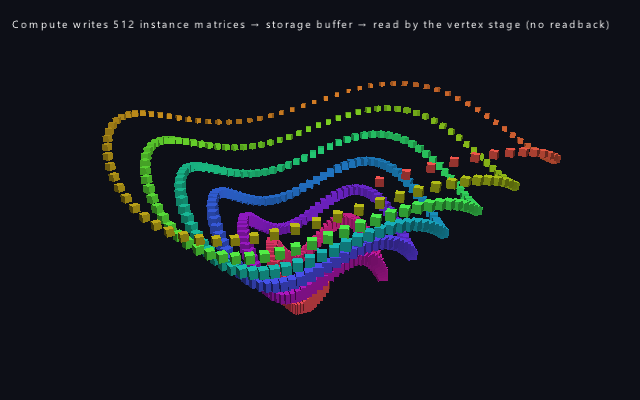 |
Kernel writes an image2D, the render pass samples it | Kernel writes instance matrices, the vertex stage reads them |
vio_cooperative_matrix_shapes
array vio_cooperative_matrix_shapes(VioContext $context)The cooperative-matrix shapes (VIO_FEATURE_COOPERATIVE_MATRIX, GLSL GL_KHR_cooperative_matrix): the subgroup-scope tiles a compute kernel can multiply with coopMatMulAdd. Each entry is ['m' => int, 'n' => int, 'k' => int, 'a' => string, 'b' => string, 'c' => string, 'result' => string] – A is M × K, B is K × N, C and the result M × N; types are 'float16', 'float32', 'sint8', 'uint8', 'sint32', 'bfloat16', …
| Backend | Shapes |
|---|---|
| Vulkan | The device's VK_KHR_cooperative_matrix properties (subgroup scope, float16 / float32) |
| Metal | 8 × 8 × 8 simdgroup_matrix shapes (MSL ≥ 3.1, Apple7+) |
| OpenGL, D3D11, D3D12 | [] – the feature is 0 |
foreach (vio_cooperative_matrix_shapes($ctx) as $s) {
    if ($s['a'] === 'float16' && $s['result'] === 'float32') {
        $tile = [$s['m'], $s['n'], $s['k']];   // pick the kernel variant for this tile
        break;
    }
}