
Ray Tracing
Two levels of hardware ray tracing:
- Inline ray queries (
VIO_FEATURE_RAY_QUERY): an acceleration structure is bound like a texture and queried withGL_EXT_ray_query(rayQueryEXT) from fragment and compute shaders. - Ray tracing pipelines (
VIO_FEATURE_RAYTRACING): raygen, miss, hit and callable shaders launched withvio_trace_rays().
| Backend | Ray query | RT pipeline |
|---|---|---|
| D3D12 | ✅ DXR 1.1 + Shader Model 6.5 (vio_create(['shader_model' => 6])) | ✅ DXR 1.0 (SM ≥ 6.3); stages from an HLSL library |
| Vulkan | ✅ VK_KHR_acceleration_structure + VK_KHR_ray_query | ✅ VK_KHR_ray_tracing_pipeline; GLSL stages |
| Metal | ✅ MSL 2.4 | ❌ |
| OpenGL, D3D11 | ❌ | ❌ |
Where a flag is 0 the functions return false with a warning. Shader execution reordering (VIO_FEATURE_SHADER_EXECUTION_REORDER) and opacity micromaps (VIO_FEATURE_OPACITY_MICROMAP) are available on D3D12 (DXR 1.2) and Vulkan.
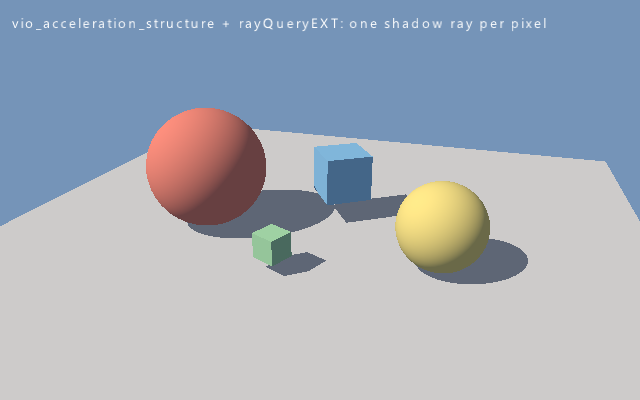
vio_acceleration_structure
VioAccelerationStructure|false vio_acceleration_structure(VioContext $context, array $instances)Build a bottom-level acceleration structure per distinct mesh (its location-0 positions and its indices) and a top-level structure over the instances. Each instance:
| Key | Type | Default | Description |
|---|---|---|---|
mesh | VioMesh | required | Geometry |
transform | float[16] | identity | Column-major 4 × 4 matrix |
hit_group | int | 0 | 0–7: hit group of the RT pipeline |
mask | int | 0xFF | 0–255: rays skip the instance when mask & cullMask is 0 |
opacity_micromap | array | none | Map of the mesh, see Opacity micromaps. A mesh carries one map |
$occluder = vio_mesh($ctx, ['vertices' => [-1,-1,0.5, 0,-1,0.5, 0,1,0.5, -1,1,0.5],
                            'indices' => [0,1,2, 0,2,3], 'layout' => [VIO_FLOAT3]]);
$tlas = vio_acceleration_structure($ctx, [
    ['mesh' => $occluder],
    ['mesh' => $occluder, 'transform' => [1,0,0,0, 0,1,0,0, 0,0,1,0, 1,0,0,1]],   // moved +1 in x
]);
Opacity micromaps
Rays through alpha-tested geometry (leaves, fences, grates) normally run an any-hit shader for every triangle they touch, only to read a texture and learn that the ray passes through. An opacity micromap stores the answer per micro-triangle in the acceleration structure, so the hardware decides during traversal. Only what the map cannot decide still runs the shader.
Micromaps speed up ray tracing through alpha-tested geometry. Ray tracing itself does not need them, and opaque geometry gains nothing from them.
Each triangle splits into 4^subdivision micro-triangles. A state is one byte:
| State | Meaning | With format 2 | With format 4 |
|---|---|---|---|
| 0 | Transparent | ray passes | ray passes |
| 1 | Opaque | ray hits, no any-hit | ray hits, no any-hit |
| 2 | Unknown, leans transparent | – | any-hit decides |
| 3 | Unknown, leans opaque | – | any-hit decides |
The geometry of a mesh with a map becomes non-opaque. RAY_FLAG_FORCE_OMM_2_STATE / gl_RayFlagsForceOpacityMicromap2StateEXT resolves the unknown states without an any-hit shader.
vio_opacity_micromap_bake
array vio_opacity_micromap_bake(array $options)Bake a map from an alpha texture. It needs no GPU and no context, so it can run in a build step.
| Option | Type | Default | Description |
|---|---|---|---|
uvs | float[] | required | u, v per vertex |
indices | int[] | 0, 1, 2, … | The mesh's indices |
data | string | required | width × height × channels bytes |
width, height | int | required | 1–65536 |
channels | int | 4 | 1 or 4; the last channel holds alpha |
subdivision | int | 4 | 0–12 |
format | int | 4 | 4: exact image, unknown states run the any-hit shader. 2: no any-hit needed, edges as coarse as the subdivision |
threshold | float | 0.5 | Alpha at or above this is opaque |
clamp | bool | false | false: uvs repeat |
Returns ['subdivision', 'format', 'states', 'stats'], which goes straight into 'opacity_micromap'. stats counts transparent, opaque, unknown_transparent and unknown_opaque. Malformed input and more than 256 MiB of states throw a ValueError.
$map = vio_opacity_micromap_bake([
    'uvs' => [0,0, 1,0, 1,1, 0,1], 'indices' => [0,1,2, 0,2,3],
    'data' => $rgba, 'width' => 256, 'height' => 256,
    'subdivision' => 6, 'format' => 4,
]);
$tlas = vio_acceleration_structure($ctx, [['mesh' => $leaf, 'opacity_micromap' => $map]]);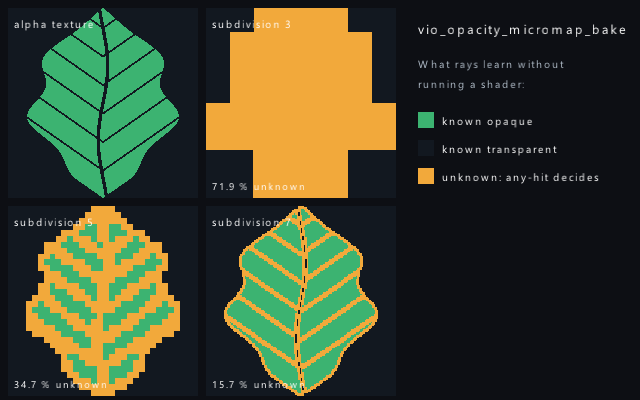
Format 4 calls a micro-triangle known only if every texel a bilinear lookup inside it can reach lies on one side of the threshold, so a known state is never wrong. Fine detail needs a higher subdivision: a coarse map finds nothing it can decide.
Measured on an RTX 2080 with 80 leaf cards, 40 crossed per ray, a 256 × 256 mask and a trivial any-hit shader:
| Subdivision | Any-hit calls saved | Bake time | Packed size |
|---|---|---|---|
| 2 | 0 % | 8 ms | under 1 KiB |
| 4 | 67 % | 52 ms | 5 KiB |
| 6 | 90 % | 87 ms | 80 KiB |
| 8 | 96 % | 370 ms | 1280 KiB |
Bake at load time or in a build step, not per frame.
Limits
- The baker reads mip 0 only, so the any-hit shader must not sample lower mips.
- Inline ray queries have no any-hit stage. Unknown states are candidates the shader resolves itself, so format 2 is the simple choice there.
- D3D12 needs DXR 1.2, which an RTX 2080 reports with the Agility SDK. Below Shader Model 6.9 a ray query cannot declare micromap support in HLSL; on Agility 1.620 and later php-vio opts the pipeline in. Metal, OpenGL and D3D11 have no micromaps.
vio_acceleration_structure_update
string|false vio_acceleration_structure_update(VioContext $context, VioAccelerationStructure $accelerationStructure, array $instances)Update an acceleration structure with a new instance list (same format as vio_acceleration_structure()). Returns what it did:
| Result | When |
|---|---|
'refit' | Every instance keeps its mesh, only transforms change – the top level is updated in place (the cheap per-frame path for moving objects) |
'rebuild' | The list changes but all meshes are already in the structure – a new top level over the existing bottom levels |
'full' | A mesh is new – everything is built again |
The structure keeps its meshes alive. Call it outside vio_begin() / vio_end() (inside a frame: false + warning); it is synchronous and waits for frames still using the structure.
vio_bind_acceleration_structure
void vio_bind_acceleration_structure(VioContext $context, VioAccelerationStructure $accelerationStructure, int $binding)Bind an acceleration structure for the following draws and compute dispatches at the GLSL binding of the shader's accelerationStructureEXT, and for vio_trace_rays().
$fs = "#version 460\n#extension GL_EXT_ray_query : require\n"
    . "layout(location = 0) in vec3 wpos;\nlayout(location = 0) out vec4 o;\n"
    . "layout(binding = 0) uniform accelerationStructureEXT u_tlas;\n"
    . "void main() {\n"
    . "  rayQueryEXT q;\n"
    . "  rayQueryInitializeEXT(q, u_tlas, gl_RayFlagsTerminateOnFirstHitEXT | gl_RayFlagsOpaqueEXT, 0xFF,\n"
    . "                        vec3(wpos.xy, 0.0), 0.001, vec3(0.0, 0.0, 1.0), 100.0);\n"
    . "  while (rayQueryProceedEXT(q)) {}\n"
    . "  bool hit = rayQueryGetIntersectionTypeEXT(q, true) != gl_RayQueryCommittedIntersectionNoneEXT;\n"
    . "  o = hit ? vec4(1, 0, 0, 1) : vec4(0, 1, 0, 1);\n"
    . "}";

vio_begin($ctx);
vio_bind_pipeline($ctx, $shadowPipe);
vio_bind_acceleration_structure($ctx, $tlas, 0);
vio_draw($ctx, $fullscreenQuad);
vio_end($ctx);
vio_rt_pipeline
VioRtPipeline|false vio_rt_pipeline(VioContext $context, array $desc)A ray tracing pipeline: one raygen shader, one or more miss shaders, triangle hit groups and callables (at most 8 of each kind).
| Key | Description |
|---|---|
raygen | GLSL raygen stage (GL_EXT_ray_tracing), required |
miss | GLSL miss stage, or a list of them (traceRayEXT's missIndex picks one), required |
closest_hit, any_hit | Single hit group: closest-hit (required) and optional any-hit stage |
hit_groups | list<['closest_hit' => glsl, 'any_hit' => ?glsl]> instead of the single-group keys; an instance's hit_group plus sbtRecordOffset picks one |
callables | list<glsl> for executeCallableEXT(index) |
records | ['raygen' => bytes, 'miss' => list<bytes>, 'hit_groups' => list<bytes>, 'callables' => list<bytes>] – each group's shader record (≤ 256 bytes), read as layout(shaderRecordEXT) buffer |
max_recursion | int, default 1 |
payload_size | Bytes, default 32 (D3D12 only) |
hlsl | D3D12: the stages as one HLSL library |
Vulkan compiles the GLSL stages; the acceleration structure and the std430 buffers sit at their bindings in set 0.
D3D12 (needs vio_create(['shader_model' => 6])) compiles 'hlsl' as one DXC library (lib_6_3) with the exports vio_raygen, vio_miss / vio_miss<k>, vio_closest_hit / vio_closest_hit<k> (+ vio_any_hit / vio_any_hit<k>) and vio_callable<k>; the payload struct is the library's own, at most payload_size bytes. The bound acceleration structure is a RaytracingAccelerationStructure at t0, a buffer bound with vio_rt_bind_buffer(…, $binding) a RWStructuredBuffer / RWByteAddressBuffer at u<binding>; shader records are root constants of a local root signature (ConstantBuffer<T> : register(b0, space1)).
Returns false with a warning where the feature is 0 or a stage does not compile.
$hdr  = "#version 460\n#extension GL_EXT_ray_tracing : require\n";
$rgen = $hdr . "layout(binding = 0) uniform accelerationStructureEXT u_tlas;\n"
      . "layout(std430, binding = 1) buffer B { uint v[]; } b;\n"
      . "layout(location = 0) rayPayloadEXT uint hit;\n"
      . "void main() {\n"
      . "  uvec3 id = gl_LaunchIDEXT; uvec3 n = gl_LaunchSizeEXT;\n"
      . "  vec2 uv = (vec2(id.xy) + 0.5) / vec2(n.xy) * 2.0 - 1.0;\n"
      . "  traceRayEXT(u_tlas, gl_RayFlagsOpaqueEXT, 0xFF, 0, 0, 0, vec3(uv, 0.0), 0.001, vec3(0, 0, 1), 100.0, 0);\n"
      . "  b.v[id.y * n.x + id.x] = hit;\n"
      . "}";
$miss = $hdr . "layout(location = 0) rayPayloadInEXT uint hit;\nvoid main() { hit = 0u; }";
$chit = $hdr . "layout(location = 0) rayPayloadInEXT uint hit;\nhitAttributeEXT vec2 bary;\nvoid main() { hit = 1u; }";

$rt = vio_rt_pipeline($ctx, ['raygen' => $rgen, 'miss' => $miss, 'closest_hit' => $chit,
                             'hlsl' => $hlslLibrary /* used on D3D12 */]);
vio_rt_bind_buffer
void vio_rt_bind_buffer(VioContext $context, VioRtPipeline $pipeline, VioBuffer $buffer, int $binding)Bind a storage buffer (vio_storage_buffer()) at $binding (0–15, up to 8 per pipeline) for the following vio_trace_rays() of $pipeline. Read the result with vio_storage_buffer_read().
vio_rt_bind_texture
void vio_rt_bind_texture(VioContext $context, VioRtPipeline $pipeline, VioTexture $texture, int $binding)Bind a texture at $binding (1–15; 0 is the acceleration structure) for the following vio_trace_rays() of $pipeline. The stages read it as layout(binding = $binding) uniform sampler2D with the texture's own filter / wrap – use textureLod(), ray tracing stages have no derivatives. D3D12: Texture2D at t<binding> with a linear / repeat SamplerState at s<binding>. Rebinding replaces; up to 16 resources (buffers and textures) per pipeline; the pipeline keeps a reference.
vio_trace_rays
void vio_trace_rays(VioContext $context, VioRtPipeline $pipeline, int $width, int $height, int $depth = 1)Launch $width × $height × $depth raygen invocations (gl_LaunchIDEXT / DispatchRaysIndex) against the acceleration structure bound with vio_bind_acceleration_structure().
Outside vio_begin() / vio_end() it is synchronous – the buffers are complete on return. Inside a frame it is recorded in order with the frame's draws and async compute dispatches: later work of the frame sees its writes, and vio_storage_buffer_read() waits for it (mid-frame too).
$out = vio_storage_buffer($ctx, ['size' => 16 * 4 * 4]);
vio_bind_acceleration_structure($ctx, $tlas, 0);
vio_rt_bind_buffer($ctx, $rt, $out, 1);
vio_trace_rays($ctx, $rt, 16, 4);
$hits = unpack('V*', vio_storage_buffer_read($ctx, $out));